Most authors think that the profitability of a book starts with marketing. Marketing is very important. While exploring different ways to market your book, authors often focus on better keywords, better Amazon ads, better book covers, and better reviews. These things matter a lot. But, there is another major factor that many authors often ignore, and that is:
Printing cost
Lots of authors think about selling books, but not many people care about what happens after someone buys a book. When you sell books, with Amazon KDP paperbacks, they take the cost of printing out of the money you get from selling the book. So the less it costs to print a book the more money you get to keep from each sale of Amazon KDP paperbacks.
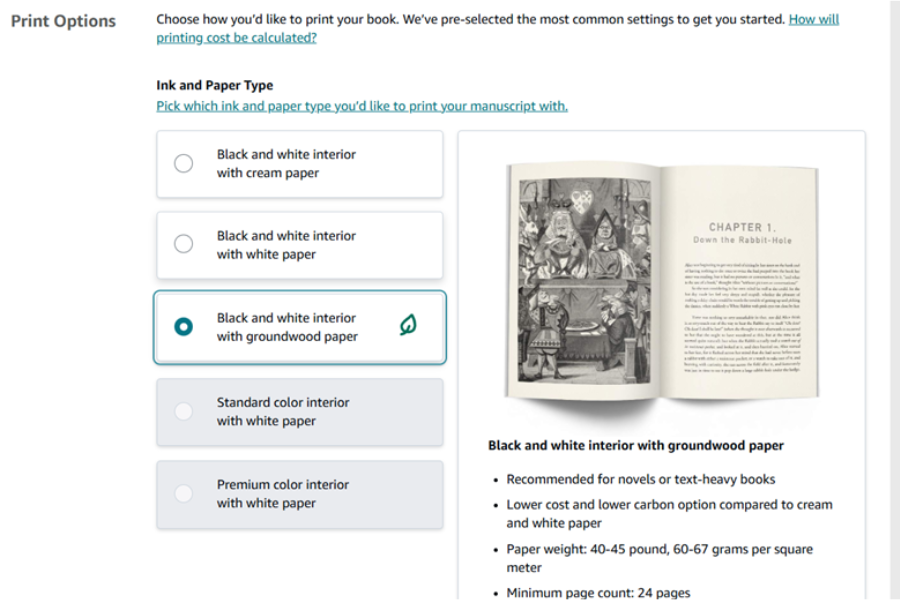
That is where Amazon KDP’s groundwood paper option comes in for Amazon KDP paperbacks. For some paperback books that are eligible, it is a simple way to spend less money on printing and get a little more money from each sale of Amazon KDP paperbacks without changing the price of your book.
Groundwood paper is mainly used for novels and other books with lots of text like paperback books. A small reduction of 5% in printing costs might not seem like a lot at first. If your book sells well over time, those savings can really add up.
Let’s look at an example to see how much of a difference it can make.
Example: 200-Page Paperback
Assumptions:
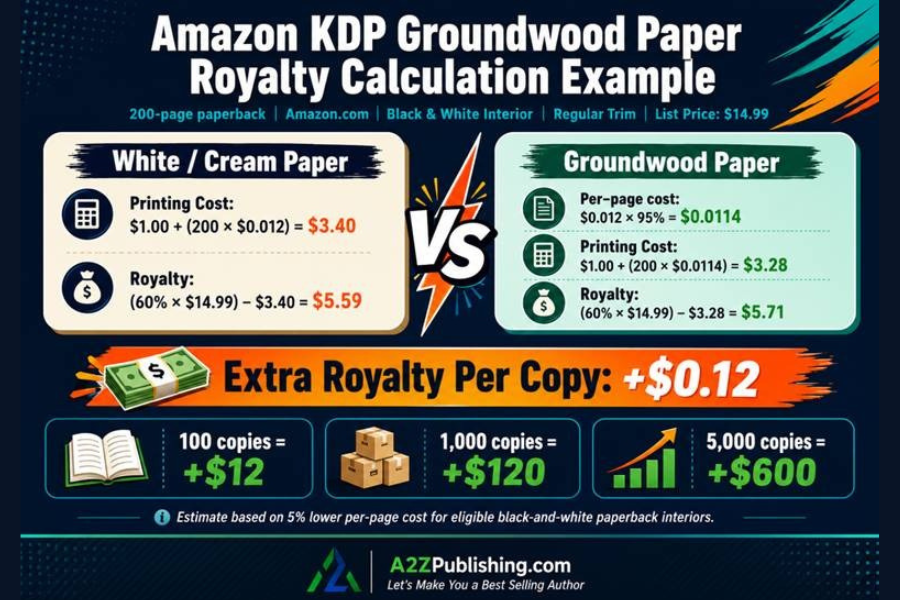
Paperback Amazon marketplace Black-and-white interior Regular trim size 200 pages List price: $14.99 Royalty rate: 60%
Amazon KDP calculates paperback printing cost using this formula:
Fixed cost + page count × per-page cost = printing cost
For white or cream paper, the printing cost is:
$1.00 + 200 × $0.012 = $3.40
Royalty calculation:
60% × $14.99 = $8.99
$8.99 − $3.40 = $5.59 royalty
Now, if we compare it with groundwood paper, groundwood will cause a reduction in the cost of each page by 5 %.
So the per-page cost becomes:
$0.012 × 95% = $0.0114
Groundwood printing cost:
$1.00 + 200 × $0.0114 = $3.28
Royalty calculation:
$8.99 − $3.28 = $5.71 royalty
The Difference
White/Cream paper royalty: $5.59
Groundwood paper royalty: $5.71
Extra royalty per copy: $0.12
This may not look like a big number.
But at scale, it matters.
100 copies = $12 extra royalty
1,000 copies = $120 extra royalty
5,000 copies = $600 extra royalty
There is no extra ad spend, no price increase, no change in the manuscript. This is just a smarter production decision.
How Authors Can Convert an Existing Paperback
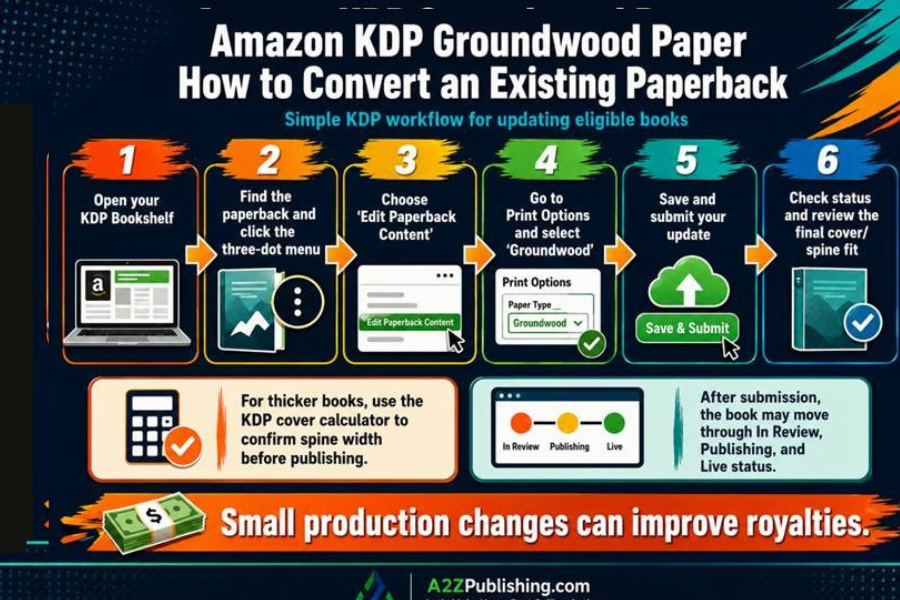
Amazon says you can switch the paper type of your existing paperback books to groundwood paper from the KDP Bookshelf.
The basic process is pretty simple. Let’s see :
- You need to sign in to your KDP account.
- Then, go to your Bookshelf.
- Next, find the paperback you want to update.
- There is a three-dot menu beside the book. Just click on that.
- Choose Edit Paperback Content.
- Go to Print Options.
- Here you can change the ink and paper type to groundwood.
- Now you have to save and submit the update.
Amazon also provides a bulk conversion option for eligible titles. When you submit your update, the book will probably change from Live to In Review, and then it will say publishing. Then it will go back to live. Sometimes, when it happens quickly, you might not even notice that the status of the book has changed. You just have to wait for Amazon to switch your paperback book to groundwood paper.
What Authors Should Keep in Mind
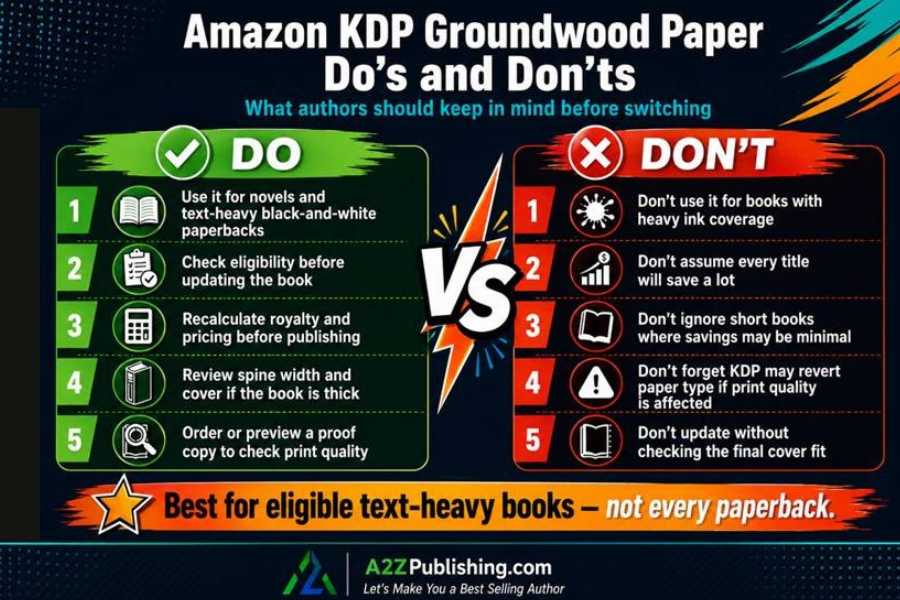
Groundwood paper is not the choice for every book. It works well for novels and nonfiction books that have a lot of text and are printed in black and white. You should not use groundwood paper for books that have a lot of ink because the ink can show through the pages. If the ink is too much, Amazon may change the paper from white to cream to make the print look better.
Authors need to check the cover before they switch to groundwood paper. Groundwood paper has a different thickness. So if a book is very thick, the spine may be wider. Amazon says authors should check the cover size if their book has more than 350 pages on cream paper or more than 525 pages on white paper.
There are some black and white paperbacks that are very short, with only 24 to 108 pages. For these books, the cost of printing is the same no matter what. So you can not save money on each page. So, the 5% per-page saving does not apply to those titles. Authors should keep this in mind when they choose groundwood paper for their books.
Final Thought
Groundwood paper is not suitable for every book. Many authors try to boost their profits by spending more on advertisements. When figuring out how to promote a book, most authors focus on selling copies. Sometimes, a better first step is to reduce the cost of each book sold. The type of paper, number of pages, book size, type of ink, cover size, list price, and profit per book are not just publishing details. They are decisions that affect profit.
For books that are mostly text and have a paperback cover, groundwood paper can be an option to try. Book profitability does not start after it is published. It starts before publishing. The cost of groundwood paper can help increase profit. Groundwood paper is a choice for authors to consider. It can help them make money from each book sold.
Want to maximise your book’s earning potential? At A2Z Publishing, we help authors make smarter publishing decisions, from formatting and production to marketing and distribution.