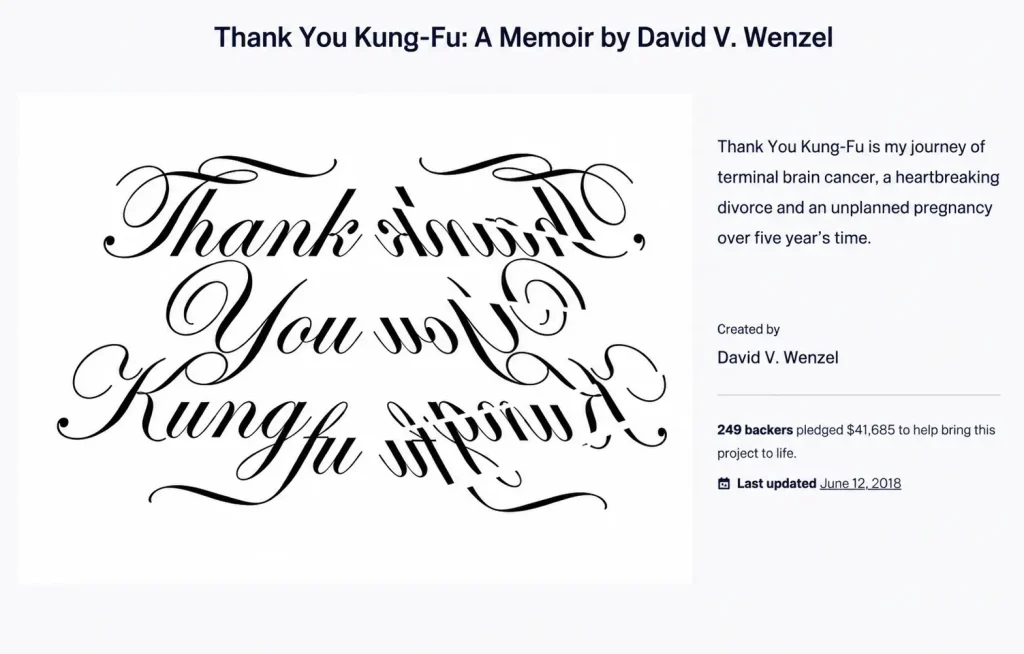
David V. Wenzel knew he didn’t have time left. He was fighting with brain cancer. He wanted to do something many people dream about but often postpone: he wanted to write his story. David wanted to write his memoir, Thank You Kung-Fu. It wasn’t another book project. He wanted to save his voice, memories, humor, pain and message.
Writing a book takes a lot of work. It needs editing, formatting, cover design, production, printing and promotion. All these things cost money. When you are sick you don’t have time or energy. Instead of giving up, David turned to crowdfunding a book, inviting people to become part of the journey of bringing his memoir into the world.
People helped David not because he wrote a book. They helped him because they understood what was important. They knew he was running out of time. They were not just helping to print pages. They were helping David leave behind a piece of himself. That’s when a book becomes more than a book. It becomes a legacy. A book like David’s is special. It’s a way to keep his memory alive. It raised US$41.6K on Kickstarter.
Why Cause-Based Publishing Works
Most authors think readers support books because of the topic, genre, writing style, or the reputation of the author. These things are important. But, when a book is written for a good reason, it is different. People like a book because of the reason it was written. They like the courage it takes for the author to tell a story that is hard to tell, the need to share a story before it is too late, and the chance that the story might help someone else.
Crowdfunding is not about asking people for money. When you are honest and respectful, it is like inviting people to be a part of something. It lets readers, friends, family, and even people you do not know help make something good happen. The idea is not “Please give me money to write my book.” A better way to think about it is, “I have a story that’s important and you can help me share it with the world’’. Cause-based publishing often works because it gives people a clear emotional reason to care:
- It preserves a story that may otherwise be lost.
- It gives family, friends, or readers something lasting to hold on to.
- It turns personal pain into something useful for others.
- It allows a community to become part of a meaningful outcome.
- It makes publishing feel human, not just commercial.
More Stories That Became Legacies
David Wenzel’s story shows that publishing can be a way to leave a lasting legacy. Lisa Wells, a mom with terminal cancer wrote “Only One of Me” for her daughter. It was a project but its message went far beyond her family. It touched on a fear we all have: how do we leave love behind for those who will miss us most?
Caroline Wright’s story is another example. She was diagnosed with glioblastoma. Turned her health updates into “The Caring Bridge Project” a memoir for her sons. Her journey shows that the first draft of a book may already exist in things, like diaries or social media updates. The story is often already there; it just needs to be put and published with care through thoughtful memoir publishing.
These stories show that a meaningful book doesn’t always start with money. Sometimes it starts with a sense of urgency, love or a memory that people can relate to. The stories of David Wenzel, Lisa Wells and Caroline Wright prove that with a purpose a book can be published with the help of a community.
What Authors Can Learn from These Campaigns
The author does not have to think about publishing as one expensive project. It is better for the author to break the publishing project into stages that are easier to manage. The author can raise money for one thing at a time like editing, then cover design then making the book look nice or printing or marketing. When the author asks people for money it is easier for people to understand and help the author if the author says what the money is for. For example the author can say “I need help raising money so I can pay for editing and that way I can share my story with everyone properly”. This is a better way to ask for help.
Authors can learn three important lessons from these campaigns:
- Purpose comes before promotion. People must understand why the book matters before they are asked to support it.
- Specific goals build trust. A campaign for editing, illustrations, or a small print run feels more believable than a vague request for funds.
- The community needs to feel included. Supporters want to feel they are helping a story survive, not just buying a product.
How to Crowdfund a Book on a Small Budget
Authors who do not have a lot of money should start with what they have. It is helpful to have a draft but this is not necessary when you first start. You can write a book using the things you already have such as diaries, letters, blog posts, recorded memories, interviews, speeches, personal reflections or even messages you wrote over time. The first thing to do is to gather all your material. Then you should think about why you want to write this book. What is the reason you want to write it? How do you want it to make people feel?
Once the purpose is clear, the author should define a realistic crowdfunding goal. Instead of trying to fund everything at once, it is better to ask for support for a specific publishing milestone. This could include:
- Editing and proofreading
- Cover design
- Book formatting
- Illustrations
- ISBN and publishing setup
- A small print run
- Ebook conversion
- Audiobook narration
- Launch and marketing support
People are more likely to contribute when they know exactly where their money will go and what outcome it will create. Using crowdfunding sites can help you reach people than trying to advertise on different platforms, which can be very expensive.
Your Community Can Become Your First Publisher
If an author can build community support for his / her book by emotional appeal then it gets traction and it can go viral. The goal is not to pressure people, but to invite them into the purpose of the book.
Before asking for money, authors should share the journey. They can post a short video, publish a sample chapter, explain the story behind the book, show early design concepts, or write openly about why the project matters. When people feel like they are part of something they are more likely to help. The authors of the book should make people understand that they are not just buying a book. They are helping the book to exist. They are helping the story of the book to survive. The story of the book is what matters.
A simple campaign plan could look like this:
- Share the personal reason behind the book.
- Explain what stage the book is currently at.
- Show what support is needed and how funds will be used.
- Offer meaningful rewards, such as signed copies, early access, acknowledgments, or donated copies.
- Keep supporters updated throughout the process.
Your Story Still Matters
A lack of money should not automatically end a meaningful book project. Money is important. It is not the first thing to think about. The first thing to think about is being clear, honest and having a reason for writing the book. If a story can help someone feel better, give them advice, inspire them to remember something or make them feel less alone then it is worth writing.
A book can be a product, a brand asset, or a business tool.Sometimes a book is much more than that. It is a message to someone, a gift to your family, a record of something brave you did or a way to make something good out of something bad. David Wenzel, Lisa Wells and Caroline Wright show us that the best books are not always the ones with the money. Sometimes they are the ones that start with a reason that other people believe in.
If you have a story that is important do not wait until everything is perfect. Start with what you have to tell people why your story matters and remember that sometimes crowdfunding a book can be the step to making your story last, for a very long time.
FAQs
How to Crowdfund a Memoir Book and Preserve Your Life Story?
To crowdfund a memoir book, an author can share the purpose behind the story and ask people to support specific publishing needs such as editing, cover design, printing, or promotion. When people connect emotionally with the story, they often help bring the book to life.
How Can Crowdfunding Help Preserve a Person’s Life Story?
Crowdfunding helps by giving authors the financial support needed to publish their stories when resources are limited. It allows friends, family, and supporters to help preserve important memories, experiences, and personal messages that might otherwise be lost.
Why Do Families Choose Books to Preserve Their History?
Families often choose books because they create something lasting that can be passed down for generations. A book helps preserve memories, life experiences, family values, and personal stories in a way that loved ones can always keep and remember.