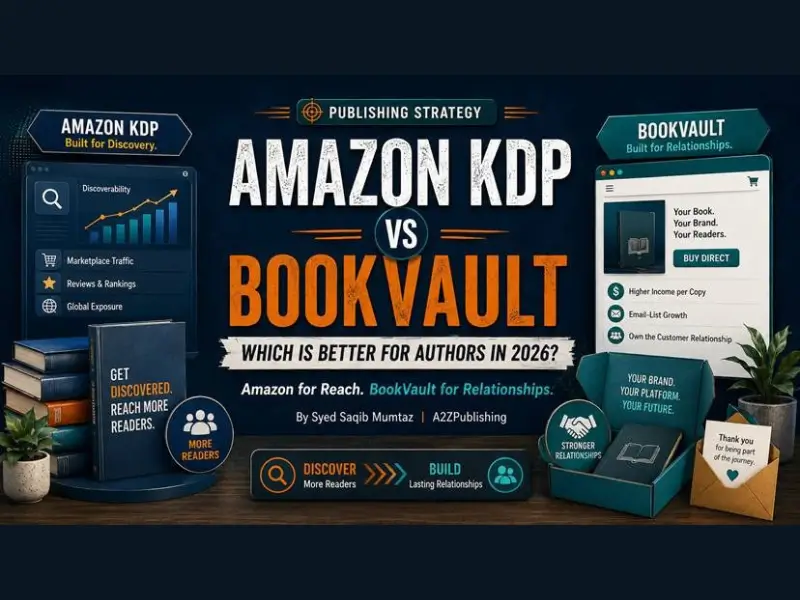
In the case of self-publishing authors, the question is no longer “Should I publish my book via Amazon?” but rather “Should I publish my book exclusively on Amazon?”
The answer for many authors is a clear no. While KDP continues to provide a strong platform for discoverability, easy purchasing, reviews, ranking, and global distribution, BookVault presents a new possibility for selling print books directly from your author site.
Amazon KDP vs BookVault: The Short Answer
| Amazon KDP is stronger for reach and discovery. BookVault is stronger for direct sales, customer ownership and potentially higher income per copy.For many independent authors, the strongest strategy is not Amazon OR BookVault. It is Amazon AND BookVault. |
Utilize Amazon to assist in marketing yourself. Use direct selling via BookVault to assist those readers in remaining connected to you.
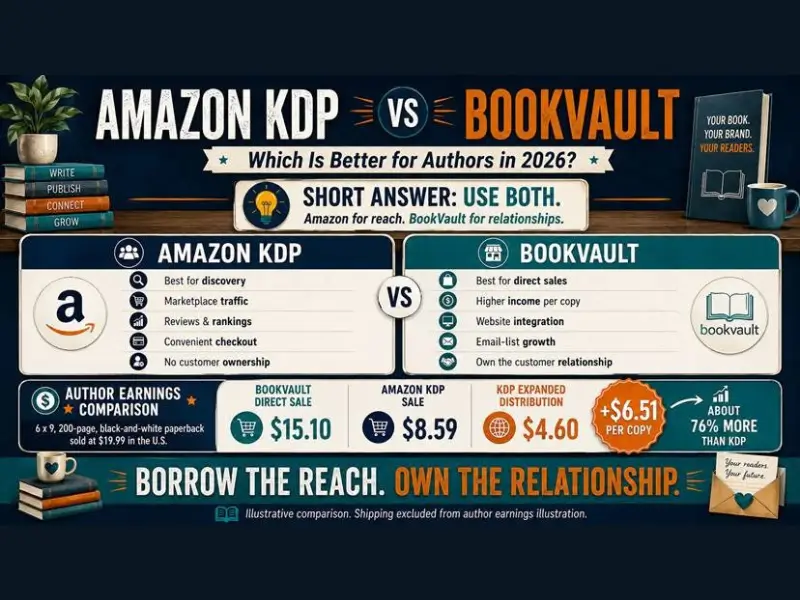
Figure 1. Amazon KDP vs BookVault at a glance: Amazon for discovery and reach; BookVault for direct sales and reader relationships.
1. Why Should Authors Still Sell on Amazon?
Traffic is what sets Amazon apart from others. Millions of customers have been visiting Amazon for the purpose of searching for, comparing, and buying books. In the U.S., the number of books that were sold via the outlets that report to Circana BookScan in 2025 was approximately 762.4 million print books. Jane Friedman describes Amazon as the leading store for self-published authors.
· An already established audience
· Familiar process for ordering/purchasing
· Reviews and social proof
· Amazon search and category visibility
· Print-on-demand paperback and hardcover
· Publication on Kindle
· No need to store inventory
The author’s royalties for a qualifying U.S. paperback by Amazon KDP are based on the applicable royalty rate minus the printing cost. Amazon continues to be an immensely valuable discovery and distribution platform.
The limitation: Amazon gives you the sale, not the customer relationship
The transaction occurs within the Amazon environment. The author gets the royalty payment, but no email address from the purchaser nor a buying relationship with the particular reader. This is the crux of the argument for direct sales.
2. What Is BookVault and How Does It Work?
BookVault is a print on demand fulfillment service. It has been integrated with several ecommerce sites including Shopify, WooCommerce, Wix, and Payhip. Once the consumer makes a purchase via the author’s website, it is then processed by BookVault for printing and fulfillment.
· No need to buy hundreds of books ahead of time
· No cartons of unsold books in your house or office
· No packing individual orders manually
· Automated fulfillment from the author’s very own storefront
· Better price control and marketing to the reader
This results in the creation of something which Amazon usually cannot offer: a connection between the author and the reader.
3. Does BookVault Pay Authors More Than Amazon KDP?
Potentially, yes. Consider an illustrative U.S. comparison for a standard 6 × 9-inch, 200-page, black-and-white paperback sold for $19.99.
| Sales route | Print cost | Other deduction | Estimated author income |
| BookVault direct sale | $4.01 | $0.88 payment processing | $15.10 |
| Amazon KDP | $3.40 | Amazon royalty structure | $8.59 |
| KDP Expanded Distribution | $3.40 | 40% royalty structure | $4.60 |
Illustrative comparison. Direct-store payment processing is estimated at 2.9% + $0.30. Shipping is excluded from this illustration.
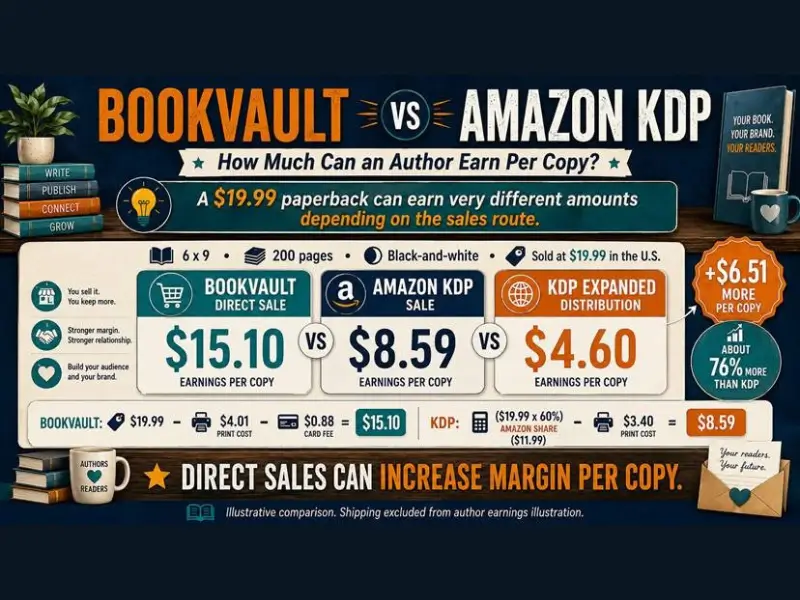
Figure 2. Estimated author earnings per copy in the illustrative $19.99 paperback example.
Amazon KDP calculation
Using the illustrative figures: ($19.99 × 60%) − $3.40 printing = approximately $8.59 author royalty.
BookVault direct-sale calculation
From the given examples:
$19.99 – $4.01 cost of printing – $0.88 fee for payment processing = $15.10 earnings estimate for author.
This is $6.51 per book more, or 76% more money earned than the regular KDP example. This would total an additional $651 on 100 copies without any fees from the ecommerce platform and without marketing or other overheads.
4. What Does an Author Gain From a Direct Sale?
Now picture two people buying the same book. The reader one is doing his purchase from Amazon.com; the author gets a royalty. Reader two buys the book directly from the author’s website; depending on how the online store is set up and if the customer gives consent, the author can get a sale along with a direct line of communication.
· An email subscription
· A future book purchaser
· A bundle purchaser
· A launch audience member
· A chance to sell again
Amazon.com can close a deal. Direct selling can generate an audience.
5. Should Authors Leave Amazon and Move to BookVault?
Not really. That is not the correct thing to conclude for the vast majority of independent writers. BookVault need not displace Amazon. The sites can have different roles within the same publishing strategy.
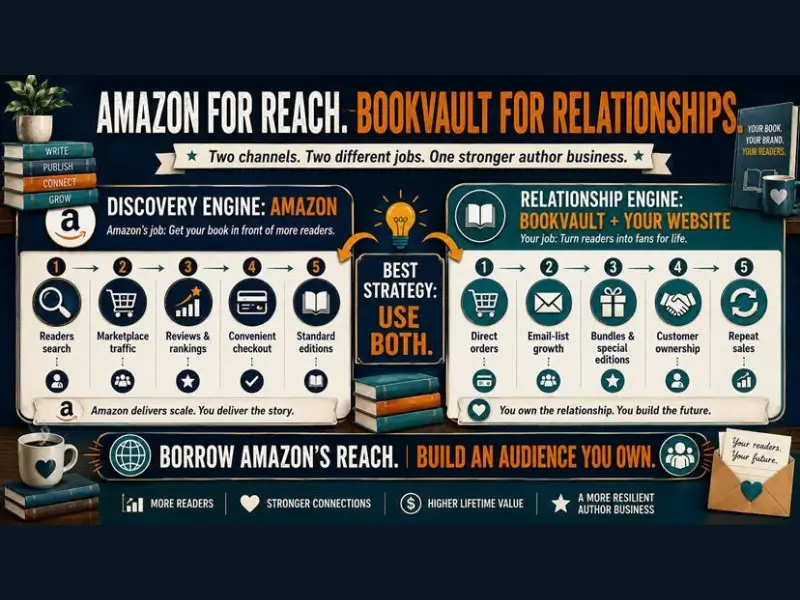
Figure 3. The hybrid author model: Amazon as the discovery engine and BookVault plus the author website as the relationship engine.
Engine One: Discovery
· Amazon search visibility
· Reviews and rankings
· Reader discovery
· Standard paperback and hardcover editions
· Kindle publishing
· Convenient mainstream purchasing
Engine Two: Relationships
· Direct sales
· Reader data collected with consent
· Email-list building
· Special editions
· Bundles and workbooks
· Exclusive packages and early access
Amazon for Reach. BookVault for Relationships.
6. When Does BookVault Become Particularly Powerful?
Direct sales get even more attractive when authors abandon their efforts to sell the exact same thing that readers can buy through Amazon.
Book + Workbook: Upgrade from a typical non-fiction book to a package for implementing it.
Signed Edition: Provide value that the regular retail listing cannot provide.
Book Bundle: Bundle several books into one bigger deal.
Book + Digital Resources: Pair the paperback book with templates, checklists or videos.
Limited or Special Edition: Make use of premium formats, special covers and other things available only as a direct sale option.
That’s when the author’s website stops being merely a copycat of Amazon. It starts providing a unique proposition.
7. What Is the Biggest Advantage of Direct Book Sales?
It is not the $6.51 difference in the example. Rather, it is that the author can know who bought the book, if the customer gives his permission and if it is the policy of the bookstore to provide such information.
An author selling 5,000 books exclusively through retailers has 5,000 customers whom he has no way of communicating with. An author having developed a database of 5,000 opt-in readers will be able to market his future books to people who are aware of his work.
· Launch a new book
· Promote pre-orders
· Invite readers to webinars
· Give out some additional chapters
· Promote a workbook/audiobook
· Promote events, consulting or coaching
· Launch future books
The key metric is not only the royalty per copy. It is the reader’s lifetime value.
8. What Is the Best Strategy for Independent Authors in 2026?
For many authors, a practical five-part model is:
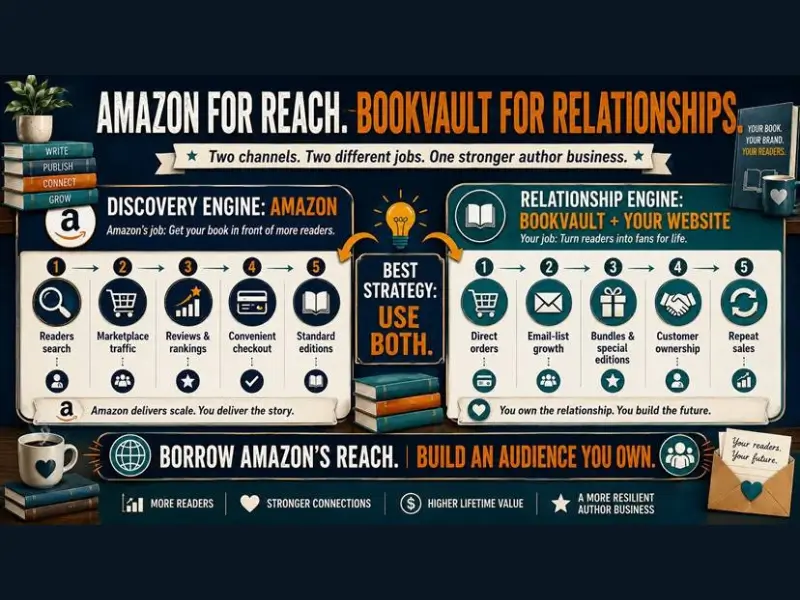
Figure 4. Five practical ways authors can use BookVault alongside Amazon to build a more sustainable author business.
1. Keep Amazon
Use Amazon for visibility, reviews, rankings and mainstream purchasing.
2. Build an author website
Make the website a sales destination, not only a biography.
3. Add direct fulfilment
Connect a print-on-demand fulfilment platform such as BookVault to the store.
4. Create direct-only offers
Use bundles, workbooks, special editions and bonus resources to differentiate the direct channel.
5. Build an owned audience
Use appropriate opt-in mechanisms to turn individual purchases into long-term reader relationships.
Amazon KDP or BookVault: Which Should You Choose?
In case of marketplace exposure being your main goal, Amazon comes out ahead. In case of wanting more control over the relationship with the customer, there should definitely be room in the strategy for direct sales. In case of wanting a sustainable authorship business, there needs to be room for both.
What Amazon has is very valuable, an existing audience. The author doesn’t have to go up against that advantage. He can utilize it while building his own.
Borrow the exposure. Own the relationship.